

Run for Yourself: How Grit, Consistency, and Injury Awareness Unlock New PRs
1. Run for Yourself, Not the Audience

Why do you lace up your shoes when the house is quiet, and the sun has not yet crested the horizon? Is it for recognition? For validation? For a digital footprint or likes on a screen? Building running consistency isn’t about external validation; it’s about true personal transformation.
True transformation in running begins when you strip away external expectations and run for an audience of one. Running is an intimate, unvarnished conversation between your feet and the road. It strips away pretense. When you step out the door, there are no shortcuts, no excuses, and no audiences cheering every step. If you run primarily for external praise, your motivation will vanish the moment the weather turns cold, the training gets grueling, or the crowd goes quiet.
When you focus on running consistency and grit for yourself, every single stride serves an internal purpose:
- You run to test the outer boundaries of your mental capabilities.
- You run to clear your mind from daily stress and noise.
- You run to build a stronger, more resilient version of who you were yesterday.
“Run the mile you’re in.”
— John Bingham
When the journey ahead feels overwhelming, legendary runner John Bingham’s advice serves as the ultimate mental anchor: stay completely present in the immediate step rather than getting consumed by the daunting distance ahead. External goals can inspire you to start, but internal drive keeps you going through the long winter months. When the victory is purely personal, the effort becomes deeply meaningful. You learn to embrace the quiet miles because they belong entirely to you.
2. The Anchor of Running Consistency
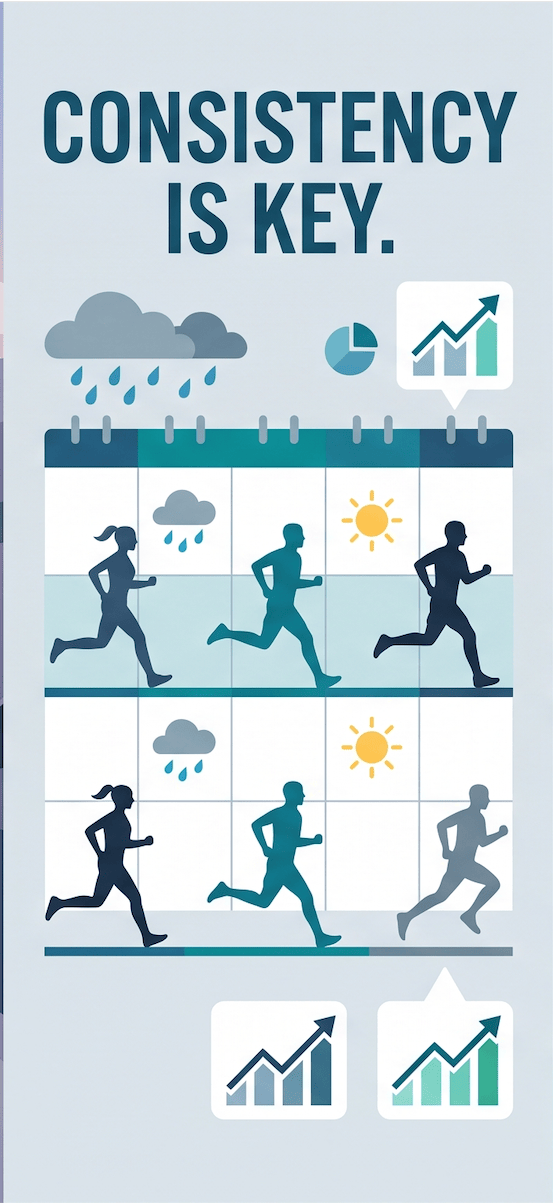
Motivation is fickle. It comes and goes with your mood, the weather, and the unpredictable stress of daily life. Relying on motivation to get your miles in inevitably leads to broken routines, missed sessions, and unrealized potential.
Long-term running consistency is the unshakeable anchor that holds your progress steady. Showing up day after day, regardless of external conditions, transforms effort into identity. A single workout—no matter how fast or how far—will not fundamentally rewrite your physiology. But that exact same run, multiplied across weeks, months, and years, rewrites your physical engine and mental fortitude.
Small, continuous efforts compound over time.
Routine turns effort into habit.
Habit turns effort into extraordinary results.
Building consistency removes the mental friction of decision-making. When training becomes part of who you are rather than just something you do, you eliminate the internal debate on dark mornings. You simply lace up, step outside, and execute the work.
3. Grit, Determination, and Breaking Barriers

Progress rarely lives inside your comfort zone. Real growth sits right past the point where your mind begs you to slow down and quit.
During hard tempo sessions, interval workouts, or the late stages of a long run, every runner meets the mental wall. Your heart rate surges, your legs feel heavy with lactic acid, and a quiet, seductive voice in your head starts offering logical excuses to stop:
- “You’ve worked hard enough today; it’s okay to cut this short.”
- “It’s fine to step back and take it easy.”
- “You can always try again next week.”
Silence that self-limiting chatter immediately. Remember this fundamental truth:
“The voice in your head that says you can’t do this is a liar.”
In almost every scenario, your central nervous system signals fatigue long before your muscle tissue reaches true physiological failure. The mind acts as a governor, trying to protect you by encouraging you to stop long before your actual limits are reached. Developing true running grit is the conscious refusal to yield to that voice. Determination is keeping your legs turning over through the heavy burn, making the active choice to embrace the pain, and not let it beat you.
“When your legs can’t run anymore, run with your heart.”
— Dean Karnazes
As ultramarathon legend Dean Karnazes reminds us, when physical energy feels completely depleted, you must reach deeper into your emotional reservoir. When you intentionally push through mental and physical barriers, you access a level of strength you didn’t know existed. You realize that your previous ceilings were merely self-imposed boundaries.
4. Unlocking New Heights and PRs

Personal Records (PRs) are never forged on race day alone. They are earned in the unseen, quiet moments: during rainy morning tempos, windy interval sessions, and those painful final track reps when nobody is watching.
The Breakthrough Formula: Discomfort + Intelligent Preparation + Mental Grit = Personal Record
To reach new athletic heights and learn how to achieve a PR, you must make peace with temporary discomfort. You cannot expect extraordinary breakthroughs while repeating comfortable efforts. Stepping up to a higher tier of performance requires stepping directly into physical and mental friction.
When you train your mind to stay calm while your body is under intense physical demand, race day transforms from a terrifying test into a joyful celebration of your preparation. Crossing the finish line with a new PR is far more than a numerical achievement—it is tangible, undeniable proof that you confronted your limits, shattered them, and redefined what you are capable of achieving.
5. The Fine Line: Pushing Hard vs. Staying Healthy
While mental toughness is crucial, there is a vital distinction between productive suffering and destructive overload. Grit without self-awareness is not bravery—it is a fast track to stress fractures, tendonitis, and months on the sidelines.
To build a lifelong running career, mastering smart running injury prevention is mandatory. You must develop athletic maturity and learn to read the subtle signals your body sends during heavy training load:
| Signal Type | What It Feels Like | Recommended Action |
|---|---|---|
| Productive Discomfort | Symmetrical muscle fatigue, heavy breathing, aerobic burn | Push through with grit, maintain form, and finish the set |
| Warning Signs | Sharp twinges, single-sided joint pain, altered stride, lingering aches | Stop immediately, assess, rest, and prioritize active recovery |
Pushing through general fatigue and natural muscle soreness builds mental toughness. Pushing through acute structural pain, joint stiffness, or sharp twinges causes tissue damage that can sideline you for months. True mental strength includes the discipline to pull back when necessary.
Respect the recovery process as much as the hardest workouts on your schedule. Rest is not wasted time; it is the vital window where your body repairs microscopic muscle tears, adapts to stimulus, and builds stronger bone density. Prioritize deep sleep, nutrient-dense nutrition, hydration, and mobility work. By staying self-aware and honoring the delicate balance between hard work and recovery, you safeguard your health, unlock lasting running consistency, and keep running strong for years to come.
You can read more on recovery and resilience here.